Estimated global emissions
~6 Mt
Estimated tyre wear particles emitted globally each year in the cited literature.
TYRE DUST POLLUTION
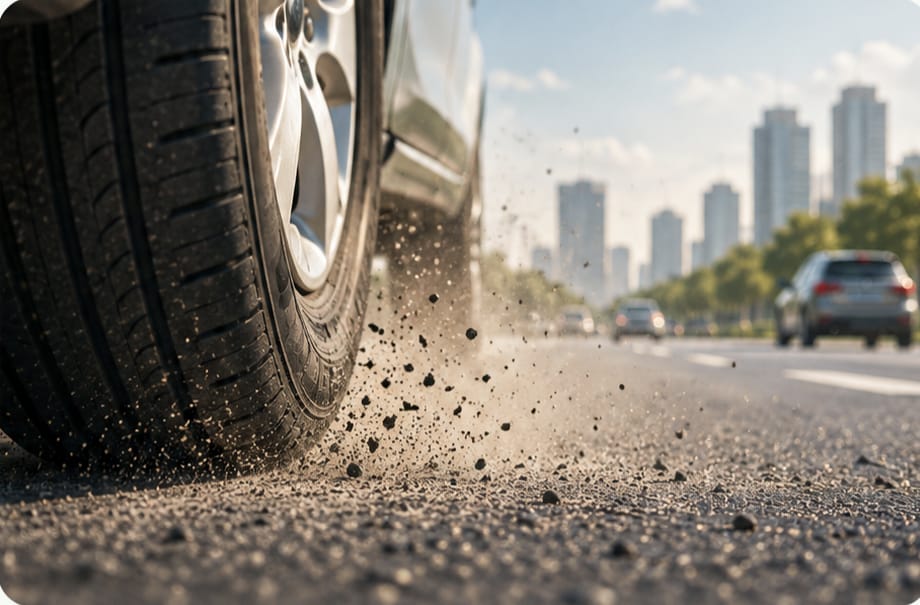
Every journey leaves something behind. As tyres meet the road, tiny particles wear away and enter the air, soil and water around us.
~6 Mt
estimated global tyre wear/year
~0.8 kg
global average/person/year
0.1–100 µm
typical particle range
GLOBAL SITUATION
Tyre wear is a non-exhaust source of particulate pollution. Unlike exhaust emissions, it remains even as vehicles become cleaner.
Estimated global emissions
~6 Mt
Estimated tyre wear particles emitted globally each year in the cited literature.
Per person
~0.8 kg
Approximate global average tyre wear emitted per person per year.
PM2.5 contribution
5–30%
A modelled range for the share of traffic-related PM2.5 attributed to tyre wear, depending on local conditions.
Important: these are estimates rather than a single universal measurement. Results vary with fleet composition, tyre type, road surface, driving behaviour, weather and local emissions.
REGIONAL VIEW
Vehicle numbers, vehicle weight, distance travelled and road conditions all influence tyre-wear emissions.
A region with more vehicles does not automatically have the highest emissions per vehicle. Vehicle weight, kilometres travelled, tyre composition, road surface and driving style all influence wear.
The key message
Cleaner exhaust does not eliminate non-exhaust pollution.
WHY DOES IT HAPPEN?
Tyre dust is created through ordinary interaction between tyres and roads.
Tyres abrade against the road surface every time a vehicle accelerates, brakes or turns.
Abrasion releases particles typically between 0.1 and 100 µm; the finest fraction can remain airborne.
Settled particles are re-suspended by passing traffic and washed into drains by rain.
Heavier vehicles, higher speeds and aggressive driving can increase tyre wear.
Electric vehicles are heavier on average, which can offset some of their zero-exhaust advantage.
WHAT ARE THE IMPACTS?
Tyre-derived particles can move through several environmental pathways after they leave the road.
WHERE IS IT WORST?
Dense traffic, heavy vehicles, frequent braking and acceleration can increase tyre wear and particle accumulation.
Stop-start traffic creates frequent acceleration, braking and turning.
Heavy vehicles can create higher tyre loads and greater wear.
More vehicle kilometres can mean greater total tyre-particle emissions.
Runoff can move road particles toward rivers and marine environments.
REAL IMPACT ON OUR PLANET
Tyre particles can travel through several connected environmental pathways.
Adds to PM2.5 and PM10 in cities where exhaust emissions have already fallen.
Deposits along roads and can affect soil chemistry and organisms.
Rain and runoff carry particles into drains, rivers, lakes and oceans.
Tyre-derived chemicals and particles can affect aquatic life and other organisms.
DAILY LIFE
Tyre dust is closely connected to the way we move around cities.
Every kilometre driven causes some material to be lost from the tyre tread.
Tyre particles mix with other road dust and can be re-suspended by traffic.
Rain washes particles from roads into drains, streams and other water bodies.
Outdoor particles can enter buildings through windows, ventilation and footwear.
ENERGY & ECONOMY
Tyre pollution creates environmental and management costs that are easy to overlook.
Particulate pollution can contribute to respiratory and cardiovascular health burdens, creating costs for individuals and communities.
Street cleaning, drainage maintenance and sediment management can require additional resources.
Where runoff contains high pollutant loads, water treatment and ecosystem restoration can become more important.
Vehicle policy is increasingly looking beyond tailpipe emissions to include non-exhaust sources such as tyre abrasion.
WHAT CAN WE DO?
There is no single solution. Vehicle design, driving behaviour, infrastructure and transport choices all matter.
1. Keep tyres correctly inflated and properly aligned.
2. Choose tyres designed for lower abrasion where suitable.
3. Drive smoothly and avoid harsh acceleration and braking.
4. Reduce unnecessary vehicle trips and vehicle weight where possible.
5. Support road-runoff filtration and effective street sweeping.
6. Use public transport, cycling and walking infrastructure where practical.
Better tyres and better driving can reduce wear, but reducing unnecessary vehicle kilometres through public transport, walking and cycling can address the source even more directly.
QUICK FACTS
A car tyre can lose roughly 100–200 g of mass over its life per 1,000 km driven, depending on conditions.
Tyre wear is estimated to be a leading source of primary microplastics entering the environment.
Tyres contain synthetic rubber, carbon black, silica, oils and chemical additives.
Non-exhaust emissions can rival or exceed exhaust particulate emissions in some urban environments.
SOURCES
The Tyre Dust information is based on the sources used in the original Tyre Dust concept.
EARTHAWARE
Tyre dust is only one part of the environmental picture. Keep exploring the topics that shape the places where we live.
Explore all topics